In the Shadow of Katahdin - Hiking The Owl
Baxter State Park in the north woods of Maine has long been one of my favorite places to escape and recharge. With few people, essentially no cell service, and very few amenities, it's the perfect place to leave the noise of modern life behind and surround yourself with nothing but the sights, sounds, and smells of nature. With over 209,000 acres of wilderness within its borders, it's entirely possible to find yourself in a place where you're the only human for miles.
I've been to Baxter many times since I moved to Maine in 2017, and have been steadily working my way down the list of trails and summits. Some, like Katahdin and South Turner Mountain, I've hiked a number of times, while others, like the Brothers or the Traveler Loop, remain on my to-do list, patiently waiting their turn. When a friend offered me a night at the Katahdin Stream campsite they couldn't use due to a scheduling conflict, I decided to take the opportunity to check one of those boxes, one that I had been eyeing for a while: The Owl (and not just because I'm an owl nerd and really like the name).

The illuminated rocky cliffs of The Owl with The Klondike, The Brothers, and Doubletop Mountain in the background, as seen from the Hunt Trail on Katahdin in 2025
The 3.3 mile Owl trail begins at the Katahdin Stream campground, and shares the first mile or so of the trail with the famed Appalachian Trail. The A.T.'s northern terminus lies a mere 3.6 miles and 3,500' of rather strenuous climbing away from where it splits from The Owl trail, and is the last obstacle northbound thru-hikers have to face before finishing their epic journey. That first shared mile of trail is a fairly gentle slope, a nice warm-up with the ambiance of Katahdin Stream running downhill to your right to help get the blood flowing. Then you get to the split, and the warm-up is over.


The Owl to the left, the Hunt/Appalachian Trail to the right
If you take a short detour down the Appalachian Trail before beginning the climb, you'll find Katahdin Stream Falls, a beautiful waterfall that looks especially striking in the fall surrounded by vibrant foliage. I didn't take the detour this year, but on my hike up Katahdin last autumn I took the time to snap a few pictures (pro tip: being a photographer gives you a lot of excuses to stop and catch your breath on hard hikes).

The Owl trail climbs through some gorgeous mossy spruce-fir forests as it works its way up the mountain. Thanks to some recent moisture, the moss seemed to be glowing a vibrant green on the forest floor, contrasting nicely with the red fir needles on the trail itself. The moisture also apparently created perfect conditions for mushrooms, as I observed at least 15 species growing alongside the trail (though sadly didn't have the right lens to really photograph them). A short nearly flat sidehill after a stream crossing is the last chance to rest your legs before the challenging section of the climb begins, sending you up 1,500' in 1.3 miles.
A magical section of mossy trail, and a Gypsy Mushroom surrounded by Reindeer Lichen and vibrant moss
Eventually, the mountain begins rewarding you for your hard work with the first small views. From one opening, you get a nice look at distant mountains to the southwest, which were reminscent of the layers of the Smoky Mountains thanks to some wildfire smoke making its way through the area. From another, you get a glimpse of the ridge up which the Hunt/Appalachian Trail climbs, and if you look carefully you can pick out the silhouettes of hikers making their way up the boulders.
The first look at the Hunt/Appalachian Trail as it climbs one of Katahdin's ridges. Smoke obscures the landscape and turns distant mountains into silhouettes.
The climb continues, getting more bouldery and rugged as the top gets nearer and nearer. But at long last, you emerge out of the trees into a wide open rocky shoulder, which has incredible views of the true summit, the Appalachian Trail, and the distant landscape. Perhaps the most striking feature is the huge rock face below the summit, which looms over you before plunging down into the valley below. That valley is also home to an impressive looking waterfall (which intrigues the part of me that loves a good bushwhack through the forest), visible just to the right of the rock face.

The huge rock face plunging down into the valley below
Even though I was having fun exploring all the views the shoulder afforded me, I knew there was still more mountain to climb, so I eventually put my pack back on and continued upwards, stopping a number of times to take more photos as the changing rocks offered some interesting foreground options. One precariously balanced boulder in particular made for a unique subject, and really emphasized the scouring effect the harsh winters have on the granite up here.
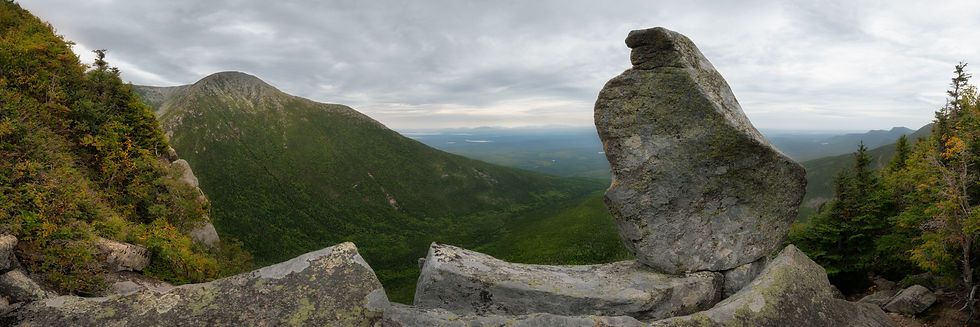
A boulder, scoured by harsh winters and past glacial activity into a graceful, curved shape
Views along the way to the true summit
Finally, I reached the nearly 360 degree views of the summit. While the view of Katahdin was essentially the same as it had been down on the shoulder, the summit offered a wide open view of the northern portion of Katahdin, as well as the untamed wilderness of The Klondike and the range of summits that include The Brothers beyond that. But the most eye-catching feature were the fir waves, a fairly rare phenomenon that's only found in a few places in the world.
Fir waves on the slopes of Katahdin viewed from the summit of The Owl
Fir waves form when older trees succumb to the harsh drying winds of the mountains and die, leaving a gap in the canopy. This then exposes the downwind trees to more wind and the process repeats, creating a line of dead trees that slowly follows the direction of the prevailing winds. As the large trees die, small trees sprout up from the undergrowth to replace them, sheltered by the larger upwind trees that are farther along in the regeneration process. This process takes places over the course of decades, generally taking about 60 years here in Maine. This phenomenon is known as a regeneration wave, and would indeed look similar to waves in the ocean if you could speed up time and watch this process unfold over the past several hundred years.
After a nice long break taking in the sights, I knew it was time to head back down the mountain. In true Baxter State Park fashion, climbing down and navigating the large rocks and large steps was quite the adventure, but having trekking poles to soften the landing impact helped save my knees a little bit. This hike is easily one of my top three favorites in the park, thanks to the incredible close-up views of Katahdin as well as the variety of different viewpoints. I often enjoy the perspective that climbing a mountain that is smaller than its neighbors provides, and The Owl was no exception. I'm already looking forward to the next time I get the chance to climb this amazing mountain.

One last look at the view before returning to the trees
Thank you for following along, and stay tuned for the next installment!
Sounds and looks gorgeous!